Herniated / Slipped Disc
When the soft centre of a spinal disc pushes out and presses on a nerve, it can cause back or leg pain. Most cases settle with the right care — and surgery helps when they do not.
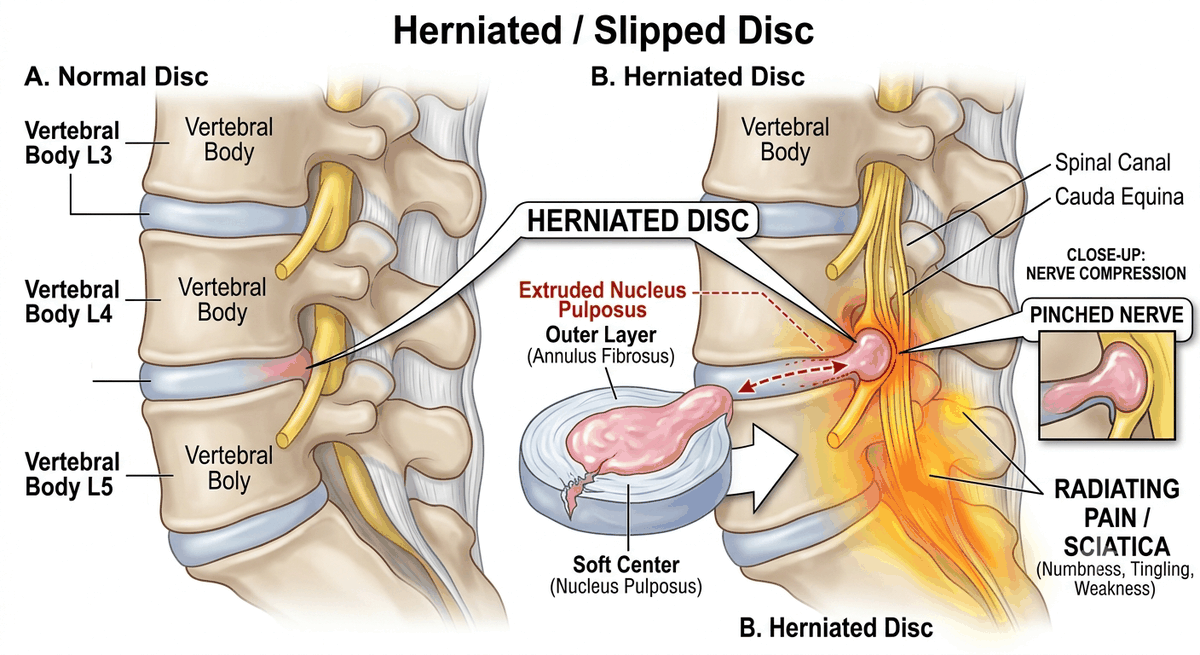
What is a herniated disc?
Each spinal disc has a soft, gel-like centre held by a tougher outer ring. A herniation (or “slipped disc”) happens when some of that centre pushes through and irritates a nearby nerve. It is most common in the lower back and neck.
Symptoms
- Back or neck pain, sometimes sudden
- Pain, numbness or tingling radiating into an arm or leg
- Muscle weakness in the affected limb
- Pain that worsens with sitting, coughing or bending
Causes & risk factors
- Age-related disc wear
- Heavy lifting or sudden strain
- Prolonged poor posture
- Genetics and smoking
Diagnosis & treatment
Diagnosis combines a clinical examination with an MRI to confirm the level and severity. Most disc herniations improve with physiotherapy, activity modification and targeted injections. When leg pain is severe or a nerve is significantly compressed, discectomy to remove the disc fragment provides rapid, reliable relief.
Frequently asked questions
Often, yes. Many herniations shrink over weeks to months, and symptoms settle with conservative care. Surgery is only needed in a minority of cases.
When leg pain is severe and persistent, or there is significant nerve compression causing weakness. Discectomy to remove the disc fragment is effective in these cases.
Struggling with back or leg pain?
Find out what is causing it and the simplest way to relieve it, with an expert spine assessment in Salem.