Spondylolysis & Spondylolisthesis Care
Precise grading and personalised treatment for pars stress fractures and vertebral slip — from bracing and physiotherapy to surgical stabilisation.
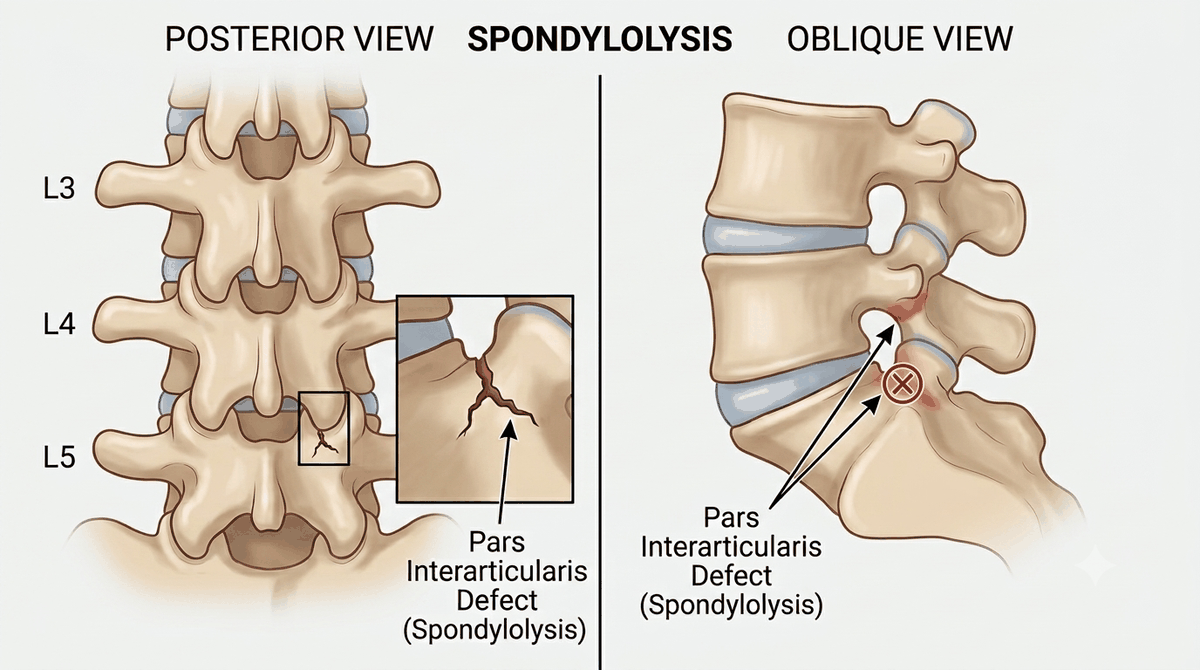
What are spondylolysis & spondylolisthesis?
Spondylolysis is a stress fracture in the pars interarticularis, a small bony bridge at the back of a vertebra — a common cause of low back pain in active adolescents and young adults.
Spondylolisthesis is when that weakness allows one vertebra to slip forward over the one below, most often in the lower lumbar spine (L4–L5 or L5–S1). Slips are graded I (mild) to IV (severe).
Symptoms to watch for
- Lower back pain that worsens with activity or bending backward
- Pain radiating into the buttocks or backs of the thighs
- Tight hamstrings and a stiff, guarded walk
- Numbness, tingling or leg weakness if a nerve is compressed
- A visible step or posture change in higher-grade slips
How Dr. Sivaraj diagnoses it
Treatment options
Non-surgical care (first for most)
- Activity modification and a structured core-stability physiotherapy programme
- Bracing for young patients with an active pars stress fracture
- Targeted injections and pain management where appropriate
Surgery (for progressing or nerve-compressing slips)
- Decompression to relieve trapped nerves
- Stabilisation and fusion to hold the vertebra in a corrected position
- Image-guided implants for accuracy and secure fixation
Recovery & outlook
Most patients improve steadily with guided rehabilitation. After surgical stabilisation, patients follow a graded return to normal activity over the following weeks — aiming for lasting relief and a stable spine.
Frequently asked questions
Most low-grade slips are stable and managed without surgery. It becomes a concern only if the slip progresses or compresses nerves — which regular assessment is designed to catch early.
A young pars stress fracture can heal with bracing and rest. An established slip will not reverse on its own, but symptoms are very often well controlled with physiotherapy and activity changes.
Yes, in most cases — with a structured rehabilitation plan and, where needed, technique adjustments. Dr. Sivaraj will guide a safe, staged return.
Concerned about back pain or a spinal slip?
Get an accurate diagnosis and a clear, personalised plan from a fellowship-trained spine surgeon in Salem.